















Coffee, chocolate and cream in a small glass: the story of the Bicerin, Turin's historic coffee houses and the city...

-
- I PIÙ VENDUTI MACINATI
- I PIÙ VENDUTI GRANI
-
- I più venduti i grani

- I più venduti macinati
-
- I più venduti i grani
 La Partenopea€7.00
- I più venduti macinati
 La Partenopea€7.00
-
Search in blog
Blog categories
Latest posts

The Bicerin and the Historic Coffee Houses of Turin
Read more

Water Is 90% of Your Espresso: Do You Know What You Are Serving? Read more
Hardness, limescale, chlorine and minerals: how water changes the taste of espresso and the life of the machine, and...

Mistakes That Ruin Café Espresso (Even With an Excellent Blend) Read more
Grinder, dose, cleaning, water and service pace: the most common mistakes that ruin café espresso and how to fix them...

Freshly Roasted Coffee: How Many Days Until It Is Ready? Read more
Freshly roasted coffee is not at its best straight away. What resting is, how many days to wait for moka, espresso...
Light, Medium or Dark Roast: What Changes in the Coffee? Read more
Acidity, sweetness, bitterness, body and caffeine: what happens to the bean during roasting and which roast to choose...
Featured posts

Swiss Water, CO₂ or Dichloromethane Decaf: What Changes?
How is caffeine removed from coffee? Water, CO₂ and solvents compared: how they work, what remains in the bean and...
Read more
How to Make Moka Pot Coffee: The Complete Guide
Dose, grind size, water and heat: everything you need for a sweet, aromatic moka pot coffee that never tastes burnt...
Read more
Whole Bean or Ground Coffee: Which Is Better to Buy?
Whole bean or ground? Pros and cons, how long the aroma lasts, when a grinder is worth it and how to choose the right...
Read more
What Is Specialty Coffee and Why Choose It?
Origins, quality, traceability and flavour: discover what specialty coffee means and how to choose your first coffee...
Read more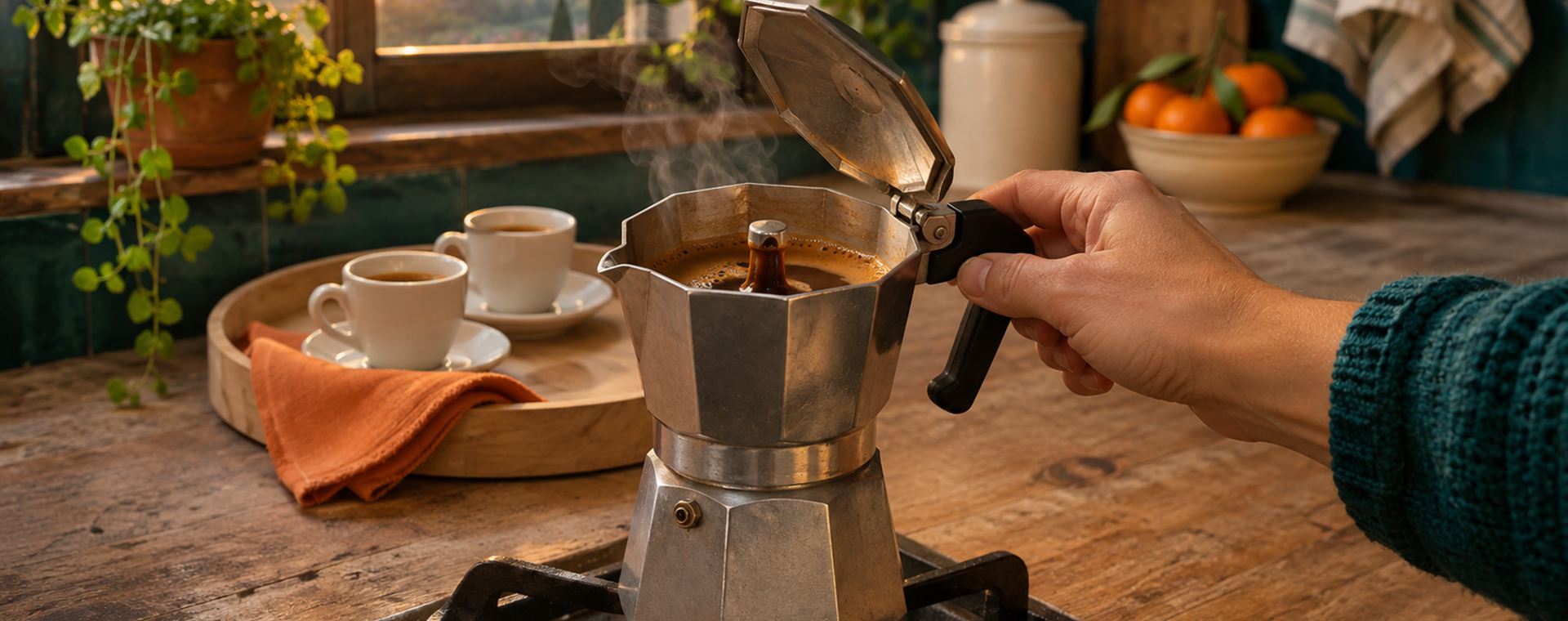
How to Make Moka Pot Coffee: The Complete Guide
The moka pot is how most Italians make coffee at home. The gurgle on the stove, the aroma filling the kitchen: it is a ritual almost everyone knows. Yet the result is often bitter, burnt or watery, and the coffee gets the blame.
In reality the moka pot is a precise tool. A few simple rules, always the same, are enough for a sweet, aromatic and consistent cup. This guide covers them all, with doses and step-by-step instructions.
What you need
- A clean moka pot with the gasket and filter in good condition.
- Coffee ground for moka, or whole beans and a grinder.
- Good water: if your tap water tastes strongly of chlorine or limescale, use a low-mineral bottled water.
- Optional but useful: a digital scale, so you can repeat the same dose every time.
The right dose
The moka pot has built-in measures: fill the boiler with water up to the safety valve, without covering it, and fill the filter basket with coffee to the rim. This gives a ratio of roughly 1 gram of coffee for every 10 ml of water.
| Moka pot | Water (approx.) | Coffee (approx.) |
|---|---|---|
| 1 cup | 50–60 ml | 5–7 g |
| 3 cups | 130–150 ml | 14–17 g |
| 6 cups | 270–300 ml | 28–32 g |
Values vary slightly between models. Weighing water and coffee the first time helps you learn your moka pot; after that, simply repeat.
Grind size
A moka pot needs a medium-fine grind: coarser than espresso, finer than filter coffee. It feels like fine table salt or caster sugar.
Too fine, and the water struggles to pass through, the pot sputters and the coffee tastes burnt. Too coarse, and the water runs through quickly, leaving a thin, sour cup. You will find every difference in our grind size guide.
Ground coffee loses aroma quickly, so grind just before brewing if you can. A hand grinder such as the Comandante C40 lets you adjust the grind precisely. If you prefer ready-ground coffee, choose one ground specifically for moka.
Step by step
- Water in the boiler. Fill to just below the valve. Using hot (not boiling) water shortens the time on the stove and reduces the risk of overheating the coffee before extraction. Careful: the boiler gets hot, so use a cloth to screw it together.
- Coffee in the basket. Pour it in without pressing, up to the rim, and level it with a finger or the back of a spoon. No mound and no tamping: a moka pot is not an espresso machine.
- Clean the edges. Brush away grounds from the rim so the gasket seals properly.
- Screw it together firmly, without forcing.
- Low to medium heat. The flame should not reach beyond the base. A slow, steady extraction gives sweeter coffee.
- Lid open. This lets you watch the coffee rise: it should flow dense and dark, not spurt.
- Take it off the heat at the right moment. When the flow turns pale and the gurgling starts, turn off the heat. You can cool the base under cold running water: extraction stops and the last, most bitter drops stay in the pot.
- Stir before pouring. The first coffee out is stronger, the last is lighter. A quick stir in the top chamber makes every cup the same.
Common mistakes
- Tamping the coffee. Water flows unevenly and the result is bitter.
- Heat too high. The coffee rushes out and tastes burnt.
- Leaving the pot on until the gurgling ends. This stage brings the most bitter notes into the cup.
- Washing the pot with detergent. Hot water is enough. Detergent leaves odours and, on aluminium pots, damages the inner surface.
- An old gasket. If it is hard or cracked, the pot loses pressure. Replace it when it no longer seals well, usually once a year with daily use.
Which coffee to choose for a moka pot
The moka pot brings out body and sweetness, but it can also surprise you with more aromatic coffees. Three ideas to start:
- For a round, sweet cup, as Brazilian coffees often are: Brazil Vila Boa ground for moka.
- To discover the floral, fresh side typical of washed Ethiopian coffees: Ethiopia Nensebo Washed ground for moka.
- For a Slow Food Coffee Coalition coffee: Mexico Nahua ground for moka.
If you love the classic taste of café espresso, try the La Serenissima blend ground for moka.
Frequently asked questions
Should the lid stay open?
It helps you watch the extraction and take the pot off the heat at the right time. If you prefer it closed, listen: at the first gurgle it is time to turn off the heat.
Can a moka pot be used on induction?
Only if it is stainless steel or has an induction-ready base. Classic aluminium pots need an adapter plate.
How often should the gasket be replaced?
Roughly once a year with daily use, or sooner if it is hard, cracked or the pot leaks steam from the sides.
A brand-new moka pot tastes odd: is that normal?
Yes. The first brews season the pot: make two or three coffees to discard before drinking the first one.
Can I use less coffee for a lighter brew?
Better not: with a half-empty basket water flows unevenly and the coffee turns watery and sour. For a lighter cup, top it up with a little hot water.
In short
Water up to the valve, a full basket without tamping, a medium-fine grind, low heat, off the stove at the first gurgle. Five gestures that cost nothing and truly change the cup. The coffee does the rest: the fresher and better it is, the more your moka pot gives back.
Posted in: Coffee Brewing Guides
Related posts
 Whole Bean or Ground Coffee: Which Is Better to Buy?
Whole bean or ground? Pros and cons, how long the aroma lasts, when a grinder is worth it and how to choose the right...
Read more Coffee Too Bitter or Too Sour? Causes and FixesBitter, sour, burnt or watery: how to tell what is wrong with your cup and which setting to change, for moka pot,...
Read more Coffee Grind Size: Which One for Moka, Espresso and FilterFine, medium or coarse? The right grind for each brewing method, how to recognise it by touch and why it changes the...
Read more How to Store Coffee and Keep Its AromaJar, fridge or freezer? Where and how to store whole bean and ground coffee, and how long it really stays good after...
Read more